If you've studied Japanese for more than a week, you've already hit the wall: は (wa) vs が (ga). Every textbook gives you a different explanation, every YouTube video contradicts the last one, and somehow you still guess wrong on JLPT practice questions.
This guide skips the philosophy. The JLPT doesn't test you on topic-vs-subject theory. It tests you on a handful of concrete sentence shapes where only one particle is correct and the other is a trap. Once you see the shapes, the choice is mechanical.
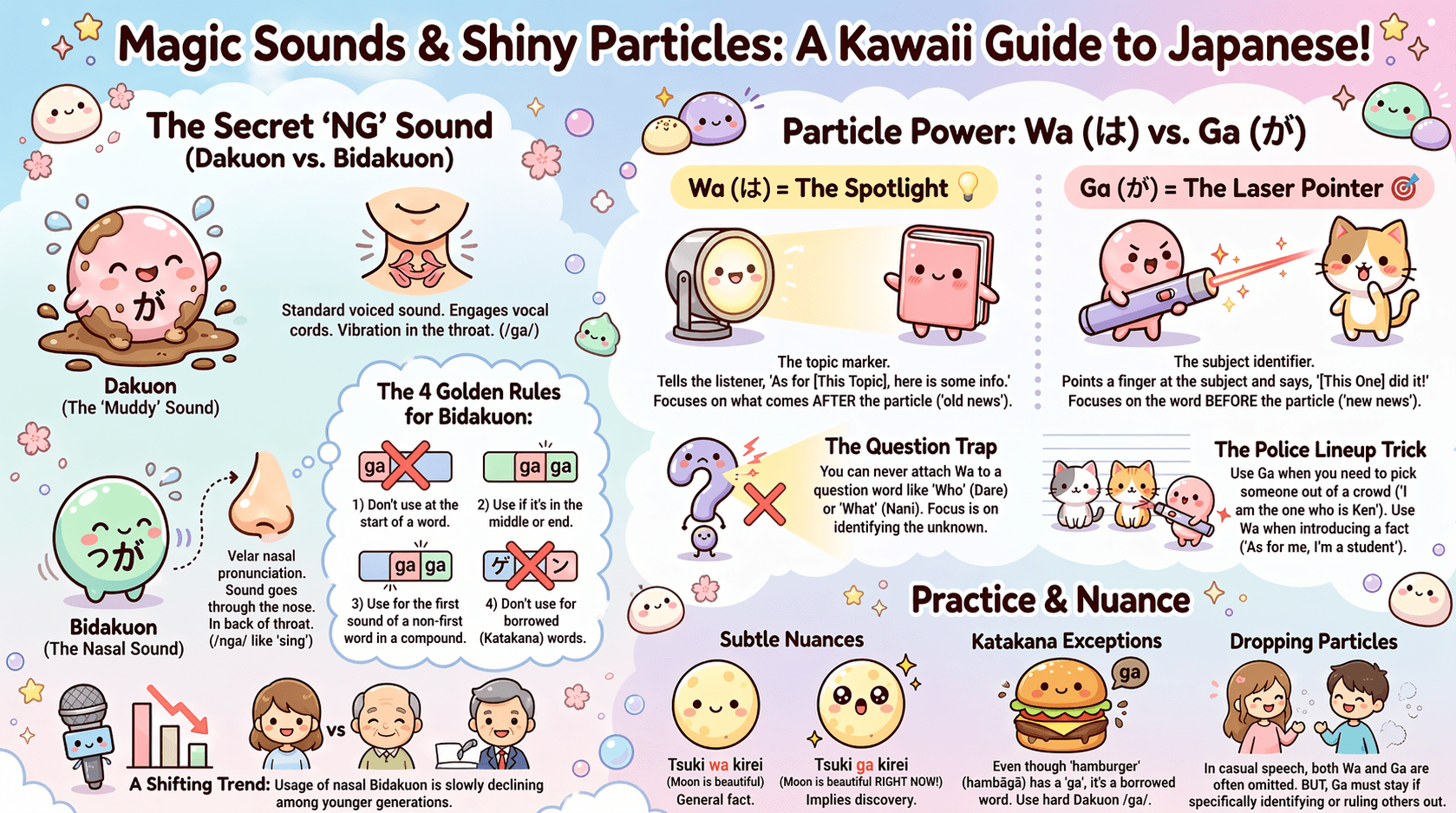
A quick visual cheat sheet for は vs が.
The 10-second rule
The core difference in one diagram
Japanese sentences have two jobs: (1) establish what you're talking about, and (2) tell us something new about it. は handles job 1. が handles job 2. Both particles can appear in the same sentence, but they're doing different work.
What each particle actually marks
は (wa) — the topic
- Marks what the sentence is **about**
- Signals "as for X" or "speaking of X"
- Introduces known, shared, or assumed information
- Can shift focus away from the actor ("As for me, I like sushi")
- Often translated as nothing at all in English
が (ga) — the subject
- Marks **who or what** performs the action or state
- Signals "it is X that…" (exclusive identification)
- Introduces new, unknown, or newly relevant information
- Answers the implicit question "who?" or "what?"
- Always attached to a specific noun doing something
When は (wa) always wins
Five sentence shapes where は is the only correct choice. Memorize these and half your wa-vs-ga anxiety disappears.
- Introducing yourself or the topic for the first time in a conversation. 「私は学生です。」 (I am a student.) — you're telling the listener what you are, framing the entire conversation around yourself.
- Contrast between two things. 「コーヒーは好きですが、お茶は好きじゃないです。」 (I like coffee, but I don't like tea.) — the two は markers pit the topics against each other.
- General statements and universal truths. 「象は鼻が長い。」 (Elephants have long trunks.) — you're making a claim about elephants as a category, not pointing at a specific elephant.
- Negative sentences about what something is NOT. 「これは私の本じゃないです。」 (This isn't my book.) — negation usually pairs with は because you're clarifying what the topic is not.
- Once a subject has been established, continuing to talk about it. Japanese frequently drops the topic after it's introduced — but when it IS restated, it's with は, not が.
When が (ga) always wins
Five sentence shapes where が is the only correct choice. These are the JLPT's favorite trap zones — if you pick は in any of these, you lose the point.
- Question words like 誰 (who), 何 (what), どれ (which) as the subject. 「誰が来ましたか?」 (Who came?) — question words can never take は. If you're asking who, the answer hasn't been identified yet, and ga is the only option.
- Answers to those question words. 「田中さんが来ました。」 (Tanaka came.) — the exclusive-identification reading: "It was Tanaka who came."
- Existence verbs: ある and いる. 「机の上に本があります。」 (There is a book on the desk.) — you're introducing new information about what exists.
- Stative verbs and adjectives describing preferences, abilities, and sensations. 「私は寿司が好きです。」 (I like sushi.) — wa marks the topic (私), ga marks what is liked. Similar patterns with 上手, 下手, 欲しい, できる, 分かる.
- Subordinate clauses (relative clauses, when/if clauses, because clauses). 「母が作ったケーキはおいしいです。」 (The cake my mother made is delicious.) — inside the relative clause, the subject takes が, not は.
The JLPT's favorite trap patterns
These three patterns appear year after year on the exam. If you don't practice them specifically, you'll guess — and guessing wrong is 1 point you didn't need to lose.
Trap 1: The question–answer mirror
The particle in the question usually matches the particle in the answer. Questions with 誰が / 何が take が in the answer. Questions with topic-style 〜は〜ですか take は.
| Question | Correct answer | Wrong answer (trap) |
|---|---|---|
| 誰が来ましたか? | 山田さんが来ました。 | 山田さんは来ました。 |
| 田中さんは何をしますか? | 田中さんは寝ます。 | 田中さんが寝ます。 |
| 何がありますか? | 本があります。 | 本はあります。 |
| この本は誰のですか? | 私のです。(no wa/ga needed) | 私はです。 |
Matching particle between Q and A
Trap 2: Main clause vs subordinate clause
The same noun changes particle depending on which clause it's in. In the main clause it's は; in the subordinate clause it's が. This one catches even advanced learners.
| Sentence | Main clause particle | Subordinate clause particle |
|---|---|---|
| 私が読んだ本は面白かったです。 | 本は (the book, topic) | 私が (I, subject inside relative clause) |
| 雨が降ったから、試合は中止です。 | 試合は (the match, topic) | 雨が (rain, subject of "because-clause") |
| 彼が来たとき、私は寝ていました。 | 私は (I, topic) | 彼が (he, subject of "when-clause") |
Same noun, different clause
Trap 3: Double-subject sentences
Japanese sometimes has two subjects in one sentence — a "big" one (topic) and a "small" one (subject of the adjective or verb). は marks the big one, が marks the small one.
| Sentence | は marks (topic) | が marks (what about it) |
|---|---|---|
| 象は鼻が長い。 | 象 (elephants) | 鼻 (the nose) |
| 彼は日本語が上手です。 | 彼 (he) | 日本語 (Japanese) |
| この店はラーメンがおいしい。 | この店 (this shop) | ラーメン (the ramen) |
| 私は時間がないです。 | 私 (I) | 時間 (time) |
は for the topic, が for the property
20 JLPT-style practice sentences
Pick は or が for each blank. Answers are listed below — cover them until you've finished all 20.
| # | Sentence | Level | Answer |
|---|---|---|---|
| 1 | 誰___このケーキを作りましたか? | N5 | が |
| 2 | 私___日本語の学生です。 | N5 | は |
| 3 | あそこに猫___います。 | N5 | が |
| 4 | リンゴ___好きですが、バナナ___嫌いです。 | N5 | は / は |
| 5 | 私___寿司___好きです。 | N5 | は / が |
| 6 | 雨___降っています。 | N4 | が |
| 7 | 田中さん___日本人ですか? | N4 | は |
| 8 | 母___作ったパン___美味しいです。 | N4 | が / は |
| 9 | 何___ありますか? —— 本___あります。 | N4 | が / が |
| 10 | 今日___天気___いいですね。 | N4 | は / が |
| 11 | 彼___結婚していると思います。 | N3 | は |
| 12 | 電気___ついたとき、みんな___驚きました。 | N3 | が / は |
| 13 | この問題___誰___分かりますか? | N3 | は / が |
| 14 | 昨日買った本___まだ読んでいません。 | N3 | は |
| 15 | 先生___紹介してくれた人___来ました。 | N3 | が / が |
| 16 | リーさん___話す日本語___とても自然です。 | N2 | が / は |
| 17 | 私___子供の頃___、この街___静かでした。 | N2 | が (or は) / は |
| 18 | 大雨___降ったにもかかわらず、試合___行われました。 | N2 | が / は |
| 19 | 注目すべき___、彼___提案した新しい方法です。 | N2 | は / が |
| 20 | 経済___回復しつつある今___、投資___増えている。 | N2 | が / は / が |
Fill in the blank: は or が?
Scoring yourself
Why this particle pair keeps tripping you up
Three reasons wa vs ga resists being "mastered" even after years of Japanese study:
- English doesn't distinguish them. In English, "I" is "I" whether it's the topic or the subject. Japanese treats those as separate grammatical roles, and your native-language instincts keep collapsing them back together.
- Context often makes both grammatically possible. Native speakers pick based on what came earlier in the conversation, what's emphasized, and what feels natural. Textbook rules approximate this but don't capture all of it.
- The rules overlap with other grammar points. Relative clauses (が only), existence verbs (が only), contrast (は only), negation (usually は) — learners who try to memorize one rule at a time keep colliding with exceptions from other rules.
The fix isn't learning more rules. It's practicing specific confusion contexts until they're automatic. Reading textbook explanations doesn't build that — seeing the same trap pattern 30 times in different sentences does.
The three things to remember
- は marks what the sentence is about; が marks who or what is doing something.
- Question words (誰, 何, どれ) and their answers always take が, never は.
- Subordinate clauses (relative clauses, time clauses, cause clauses) almost always take が inside; は stays in the main clause.
Drill the wa vs ga traps (and 50K other confusion pairs) with our free adaptive practice.
Practice Confusion Pairs →FAQ
Can a sentence have both は and が?
Yes, constantly. は sets the topic, が marks the subject of the action or state within that topic. 「私は日本語が好きです」 literally means "As for me, Japanese is liked" — は tells us the sentence is about me, が tells us what I like.
Which particle does the JLPT test more often?
が traps are more common because は feels more "neutral" to English speakers and learners default to it. The exam exploits that bias — especially in relative clauses, question-word answers, and existence sentences.
Is there a shortcut for when I'm not sure?
Ask yourself two questions: (1) Is there a question word (誰/何/どれ) or is the sentence answering one? Then it's が. (2) Is the subject inside a relative clause, a "when" clause, or a "because" clause? Then it's が. If neither applies, は is usually safe.
What about も, を, に, で, から? Do they follow the same logic?
No. Those particles mark different grammatical roles (object, direction, location, means, cause). The wa-vs-ga problem is specifically about topic-vs-subject — a distinction that doesn't apply to most other particles. Covered separately in our particle guides.
I've studied this for years and still get it wrong. Am I slow?
No. Native English speakers typically need about 500 correct exposures before wa/ga becomes automatic — not conscious review, but actual in-context use. The speed-up tool is targeted practice on confusion pairs, not more grammar explanations. Reading this post was the first exposure. The next 499 come from practice.