One of the first things Japanese learners want to express is desire - wanting something or wanting to do something. Japanese has two separate grammar patterns for this, and mixing them up is a very common mistake.
The rule is simple: use ほしい (hoshii) when you want a thing (a noun), and use たい (tai) when you want to do something (a verb).
Grammar Visual
Saying "I Want" in Japanese: Hoshii vs. Tai
Two patterns, one clear rule - objects vs. actions
Wanting a Thing
(Objects)
~ほしい
(Hoshii)
Use this marker when you want a noun - a physical thing or a concept like "a break".
水がほしいです
(I want water)
Wanting to Do
(Actions)
~たい
(Tai)
Use this marker when you want to perform a verb - an action.
飲みたいです
(I want to drink)
Created by changing "Nomimasu" (To drink) into its stem "Nomi" and adding "tai."
Side-by-Side Comparison
車がほしいです
(Object)
車をかいたいです
(Action)
休みがほしいです
(Noun)
やすみたいです
(Action)
Check Your Knowledge!
I want a camera
(Noun) →
I want to go to Japan
(Action) →
The "First-Person" Rule
These forms are only for expressing your own desires. Talking about what others want requires different grammar rules - such as ほしがっている or たがっている.
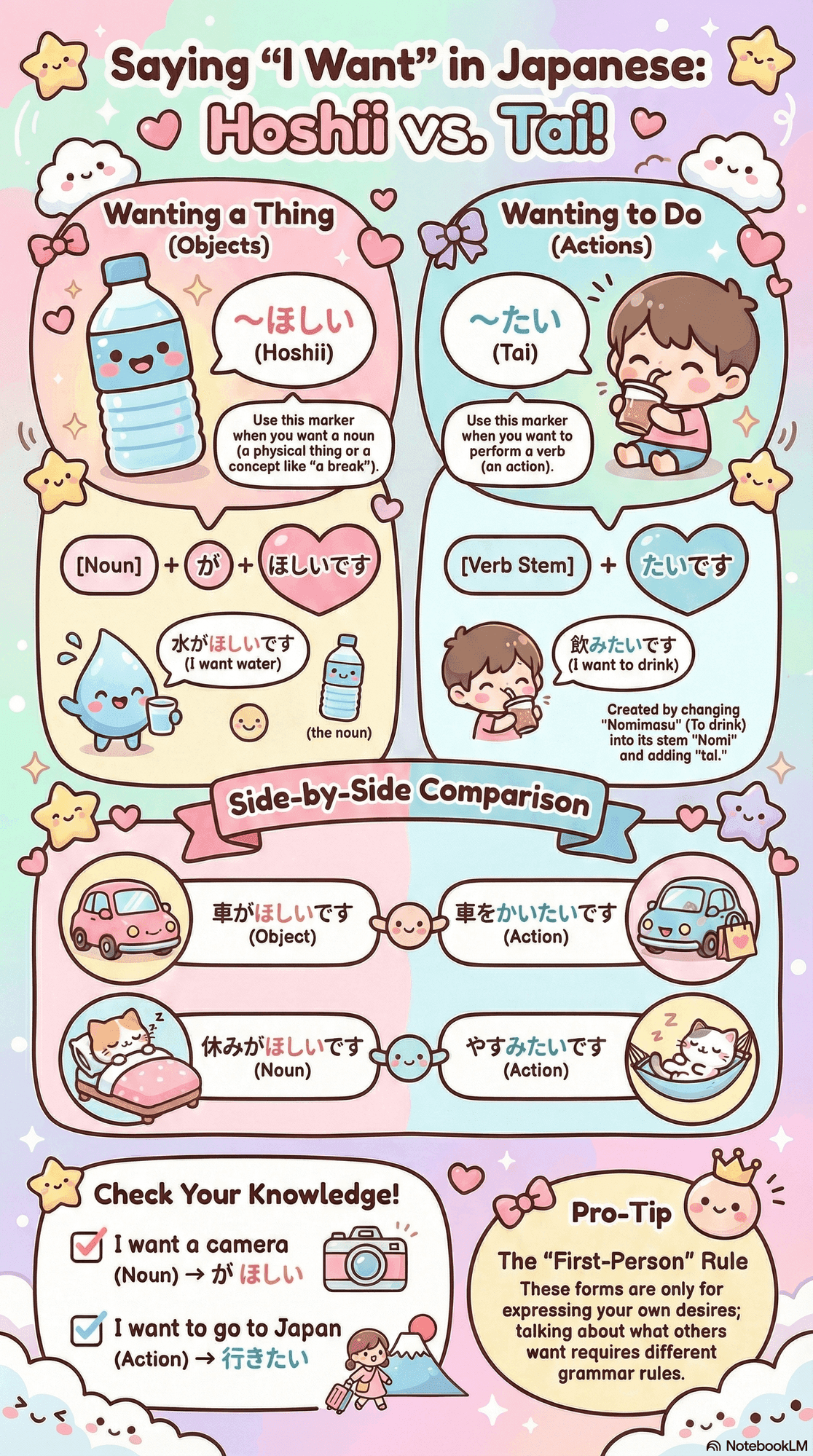
Quick visual reference for hoshii vs tai.
Breaking Down ほしい (Hoshii)
ほしい is an い-adjective that means "wanted" or "desired." You attach it to the noun you want using the particle が.
| Japanese | Romaji | English |
|---|---|---|
| 水がほしいです | Mizu ga hoshii desu | I want water |
| 新しい車がほしいです | Atarashii kuruma ga hoshii desu | I want a new car |
| 休みがほしいです | Yasumi ga hoshii desu | I want a break |
| 友達がほしいです | Tomodachi ga hoshii desu | I want friends |
Negative form
Breaking Down たい (Tai)
たい is a suffix that attaches to the verb stem (masu-stem). It conjugates like an い-adjective. The particle before the object is often を, but が is also common and natural.
To find the verb stem, take the ます (masu) form and drop ます. Example: 飲みます → 飲み → 飲みたいです.
| Dictionary form | Masu form | Stem | Tai form | Meaning |
|---|---|---|---|---|
| 飲む | 飲みます | 飲み | 飲みたいです | want to drink |
| 食べる | 食べます | 食べ | 食べたいです | want to eat |
| 行く | 行きます | 行き | 行きたいです | want to go |
| 見る | 見ます | 見 | 見たいです | want to see |
| 話す | 話します | 話し | 話したいです | want to speak |
| 寝る | 寝ます | 寝 | 寝たいです | want to sleep |
Common Mistakes to Avoid
- Using たい with a noun - ✗ 水をたいです (wrong) · ✓ 水がほしいです (correct)
- Using ほしい with a verb - ✗ 食べるがほしいです (wrong) · ✓ 食べたいです (correct)
- Talking about others' wants - ✗ 彼は水がほしいです (sounds unnatural) · ✓ 彼は水をほしがっています (correct)
- Forgetting the verb stem - ✗ 飲むたいです (wrong) · ✓ 飲みたいです (correct)
Expressing Negative Desires
Negative Forms
ほしくないです (don't want thing)
- 水がほしくないです - I don't want water
- お金はほしくないです - I don't want money
- プレゼントはほしくないです - I don't want a present
たくないです (don't want to do)
- 食べたくないです - I don't want to eat
- 行きたくないです - I don't want to go
- 働きたくないです - I don't want to work
Past Tense Forms
Both patterns have past tense forms used when talking about past desires or things you wanted (but may no longer want).
| Form | Japanese | English |
|---|---|---|
| ほしい past | ほしかったです | wanted (a thing) |
| ほしい past neg | ほしくなかったです | didn't want (a thing) |
| たい past | たかったです | wanted to (do) |
| たい past neg | たくなかったです | didn't want to (do) |
Quick Reference
Hoshii vs. Tai - The essentials
- ほしい (hoshii) = wanting a thing (noun). Pattern: [Noun] + が + ほしいです
- たい (tai) = wanting to do something (verb). Pattern: [Verb stem] + たいです
- Both only express YOUR OWN desires - use different forms for others
- Negative: ほしくないです / たくないです
- Past: ほしかったです / たかったです
Ready to practice ほしい and たい? Test yourself with JLPT-style questions.
Practice N5 Grammar